

It was a grand journey to Gartan in County Donegal, the birthplace of the great St. Columba, also known as St. Colmcille. This quiet and beautiful place is deeply tied to one of Ireland’s most important saints, whose influence reached far beyond Donegal and helped shape early Christian Ireland.
Watch my short video below and come along with me to this special corner of Irish history.
With the wind at my back and a real sense of reverence in my heart, I set out to explore the landscape that shaped this remarkable Irish saint. Gartan is quiet, peaceful, and full of meaning, the kind of place where you can understand how faith, nature, and Irish tradition came together in the life of St. Columba.

St. Columba, or Colmcille
In the green countryside of Gartan, County Donegal, I found myself walking through the landscape connected with St. Columba, also known as Colmcille. The hills, fields, and quiet beauty of the place made it easy to see why this corner of Ireland feels so sacred. There was a real sense of wonder in standing where one of Ireland’s great saints first began his story.

To the Birthplace of St. Colmcille
As a young lad in Offaly, I went every year on the 9th of June to the Pattern of Durrow, a celebration of St. Colmcille, who founded Durrow Abbey. So visiting his birthplace in Gartan, County Donegal felt especially meaningful to me.
This quiet little place welcomed me in its own simple way. Here, in this ancient landscape, St. Columba is said to have first drawn breath in 521 AD.
I did get a bit lost on the boreen heading up, mind you. Thankfully, a local man pointed me in the right direction. Google Maps is grand, but in a place like this, you still can’t beat asking a local.
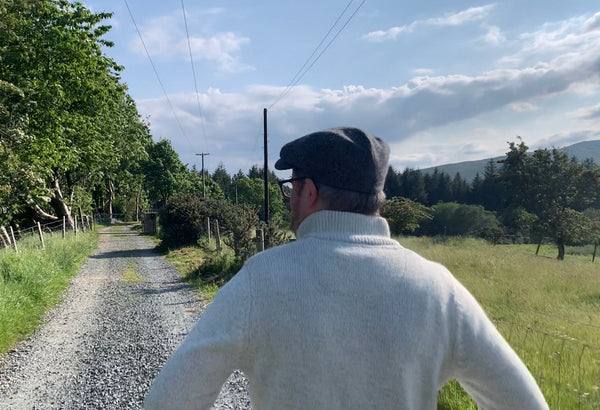
I first went to the place where St. Colmcille is said to have been born. I walked down a crunchy stone lane, the kind that makes you slow your steps and take everything in. As I got closer, a large Celtic cross came into view, standing proudly near his birthplace. It was a powerful sight, and I found myself fascinated by the quiet beauty of the place and the deep history it holds.

This was the very place where St. Colmcille is said to have been born, and standing there felt powerful. To think I was walking the same ground he once knew, in the quiet hills of Donegal, gave the whole visit a deeper meaning. It was not just a stop on a map, it felt like stepping into the beginning of one of Ireland’s great spiritual stories.

According to local folklore, Colmcille spent the night before his departure for Iona sleeping on the Flagstone of Loneliness at this site. There is something very moving about that image, a young man lying on the cold stone, preparing to leave Ireland behind and begin a journey that would shape his life, his faith, and his legacy across Scotland and beyond.

About a mile further down the boreen, I arrived at Colmcille’s Abbey, another deeply meaningful place in his story. This was where he first began his life’s mission, setting out on the path that would make him one of Ireland’s most important saints. Standing there, I felt the quiet weight of it, the beginning of a journey that would carry his name from Donegal to Iona and far beyond.

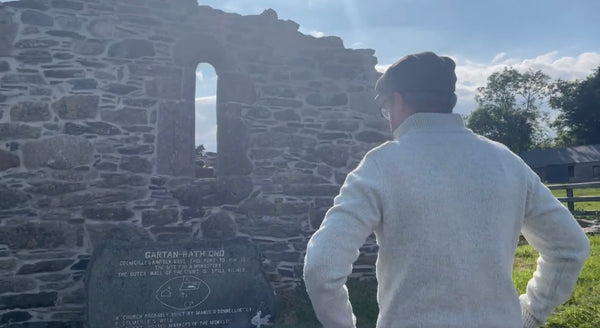
The ruins of this ancient monastery still stand as a quiet witness to St. Colmcille’s legacy. I stood there in front of the weathered stones, humbled by the thought that this was a place where he once prayed, worked, and began shaping the mission that would carry him far beyond Donegal.
It is said that Colmcille’s family gave him the land to build this abbey, and that the monastery itself was built within an old hill fort. That alone adds another layer of history to the place, faith, family, and ancient Ireland all meeting on one site.
As I walked around the monastery, I also noticed several surviving boundary crosses. They have stood there through the centuries, silent witnesses to generations of pilgrims, visitors, and curious souls like myself who came seeking a connection to this remarkable saint.
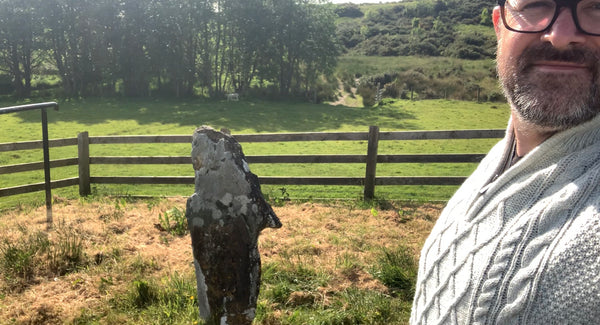

The site also contains the ruins of a 10th-century church, an old abbey said to be the burial place of O’Donnell chieftains. The O’Donnells were connected to Colmcille’s own family, which gives the place an even stronger sense of local history. We Irish have always had a way of keeping family ties close!
One of my favourite parts of the visit was the lovely Holy Well. For hundreds of years, pilgrims came here to pray, reflect, and bathe their feet in the water as part of an old devotional tradition. It is a quiet, peaceful spot, but you can feel how much meaning it held for the generations who visited before us.

And finally, my favourite part of the visit was the lovely Church of St. Colmcille, built in the 16th century by Manus O’Donnell in memory of his famous cousin. There was something very moving about standing inside it and seeing the altar still intact after all those years.
What really caught my attention was what may have been a birthing stone, adding another layer of local tradition to the church. It is said that prayers were still offered here up until the 1800s, which makes the place feel less like a ruin and more like a living memory of faith, family, and devotion.
Colmcille’s tireless work to spread Christianity across Ireland and Scotland, and his dedication to uniting the Gaelic people through faith and learning, really stayed with me. From Gartan, his journey would eventually lead him to Iona in Scotland, where his legacy grew even stronger before inspiring monasteries and communities that shaped early Christian Ireland.
As the evening sun cast a golden light across the landscape, I said farewell to Gartan with a deeper appreciation for this remarkable saint. The visit left me thinking about faith, family, heritage, and the lasting spirit of Colmcille — a man whose story still feels alive in the hills of Donegal.
Watch my short video below:
Why not explore more while you’re here?
Have a look at our Celtic Cross Collection, inspired by the ancient crosses and early Christian heritage found across Ireland.
You may also enjoy my blog about visiting the monastery of Clonmacnoise, another remarkable place where Ireland’s faith, history, and carved stone crosses come together.
Sláinte! ☘️
Aidan 💚🇮🇪☘️
I love this thank you. We are going back to Ireland next summer and we are adding Donegal to our visit list.