
Before pumpkins, there were turnips.
Before trick-or-treating, there were groups of people going from house to house in disguise.
And long before Halloween became one of the biggest nights of the year in America, people in Ireland were already gathering at the end of October for food, games, stories, superstition and a night that felt slightly different from the rest.
The older Irish festival behind much of this was Samhain.
But the story is a little more interesting than simply saying, “Ireland invented Halloween.”
Modern Halloween grew over centuries, mixing older Irish seasonal customs with Christian traditions and, later, American culture.
Still, if you look closely at Halloween today, quite a few familiar things start pointing back towards Ireland.

So, What Was Samhain?
Samhain marked the beginning of winter in the traditional Irish calendar.
It was observed on 1 November, although, just like Halloween today, much of the activity happened the evening before on 31 October, known in Irish as Oíche Shamhna.
The days were getting noticeably shorter.
Animals had to be prepared for winter, food stores mattered more, and the landscape itself was beginning to change.
In other words, Samhain was not originally a spooky party.
It marked a very real turning point in the year.
One detail makes that especially interesting.
Samhain falls roughly halfway between the autumn equinox and the winter solstice. At the Mound of the Hostages on the Hill of Tara, a Neolithic passage tomb built thousands of years before the Celtic period, sunlight reaches the chamber around the seasonal points now associated with Samhain and Imbolc. That does not mean the tomb was built for Samhain, but it shows just how long people on this island had been paying close attention to the changing year.
Was Samhain the “Celtic New Year”?
You will see this said everywhere.
But it is not quite that simple.
Samhain is often described today as the Celtic New Year, yet historians do not actually have firm evidence that ancient Irish people treated it as the beginning of a formal new year.
The idea became especially popular in the nineteenth and twentieth centuries. Some older evidence points instead to Samhain as the beginning of the darker half of the year, while other traditions give importance to Bealtaine in May.
So calling it the “Celtic New Year” is possible as a modern shorthand.
Calling it a proven historical fact would be going too far.
And, strangely enough, the real story is more interesting anyway.

The Night When the Otherworld Felt Closer
This is where Samhain begins to sound much more like Halloween.
Irish folklore treated this period as a time when the ordinary boundary between this world and the supernatural world could become less secure.
Fairies and other supernatural beings could be abroad.
Certain places, particularly fairy forts, mounds and unusual trees, were best avoided after dark.
One of the most extraordinary places connected with this idea is Oweynagat, or the Cave of the Cats, at Rathcroghan in County Roscommon.
In medieval Irish stories, Rathcroghan was associated with the Otherworld, and Oweynagat appears as a place from which strange creatures and supernatural forces could emerge. Heritage Ireland still describes the Rathcroghan landscape as one filled with legendary palaces, prehistoric monuments and stories of portals into the Irish Otherworld.
Imagine walking through the Irish countryside hundreds of years ago.
Very little artificial light at all.
A cold October night.
Stories about spirits moving through the landscape.
Suddenly, Halloween makes a lot more sense.

And Yes, People Were Dressing Up
Costumes did not begin with plastic vampire teeth.
Irish Halloween tradition included guising, where men or children disguised themselves with masks or old clothing and went from house to house.
Sometimes they frightened neighbours.
Sometimes they performed or entertained the household in exchange for food or treats.
Sometimes they simply caused trouble.
Old folklore accounts collected around Ireland describe people disguising themselves so that neighbours would not recognise them.
So when children today put on costumes and knock on doors, the idea is not as modern as it looks.
The very tidy explanation that people dressed up specifically “to confuse spirits” is probably too simple.
Traditional Irish guising certainly existed, and supernatural beliefs certainly existed around the same night, but folklore varies from place to place and period to period.
That messiness is actually part of the fun.
Halloween was never one single tradition.
It was hundreds of local customs slowly becoming one celebration.

Before Pumpkins, Ireland Had Something Much Scarier
This might be the most Irish part of the whole story.
The original jack-o'-lantern was not a pumpkin.
People hollowed out turnips, carved faces into them and placed candles inside.
And if you are imagining something cute, do not.
They could look genuinely horrifying.
The National Museum of Ireland preserves the record of a traditional ghost turnip from Fintown, County Donegal. A teacher who donated the example in 1943 said it represented the kind traditionally made in the area around 1900.
Turnip lanterns could be carried or placed in windows and were used to frighten people on Halloween night.
When Irish traditions crossed the Atlantic, pumpkins eventually became the easier option.
They were bigger.
They were softer.
And anyone who has ever tried carving a raw turnip will probably agree that this was progress.
So the next time you see a glowing pumpkin on Halloween, there is a little Irish turnip hiding somewhere in its family tree.

Halloween Dinner Could Predict Your Future
Then there was the food.
One of the best-known Irish Halloween traditions is báirín breac, or barmbrack.
It looks harmless enough.
Traditionally, objects were baked or hidden in the brack and whoever received them was supposed to learn something about their future.
The ring predicted marriage.
A coin could suggest wealth.
Other versions included a button, thimble, rag or stick, each with its own prediction.
The exact objects and meanings varied from place to place.
Accounts collected by the Irish Folklore Commission record families cutting the brack into slices at Halloween tea and waiting to see who got the ring.
Finding jewellery hidden inside your cake sounds strange now.
At the time, apparently, it counted as entertainment.
The Ring Was Not the Only Fortune-Telling Game
Irish Halloween was full of predictions.
People bobbed for apples.
Nuts could be placed near the fire to predict romantic relationships.
Objects might be hidden beneath bowls.
Cabbages could even be pulled from the ground and examined for clues about a future husband or wife.
Halloween, apparently, was the nineteenth-century Irish equivalent of checking your horoscope, except with considerably more vegetables.
The Ring That Survived
The barmbrack ring is one of the traditions people still recognise today.
And there is something nice about that.
A small ring hidden in a cake somehow became part of a night concerned with the future, relationships and the people we might one day share our lives with.
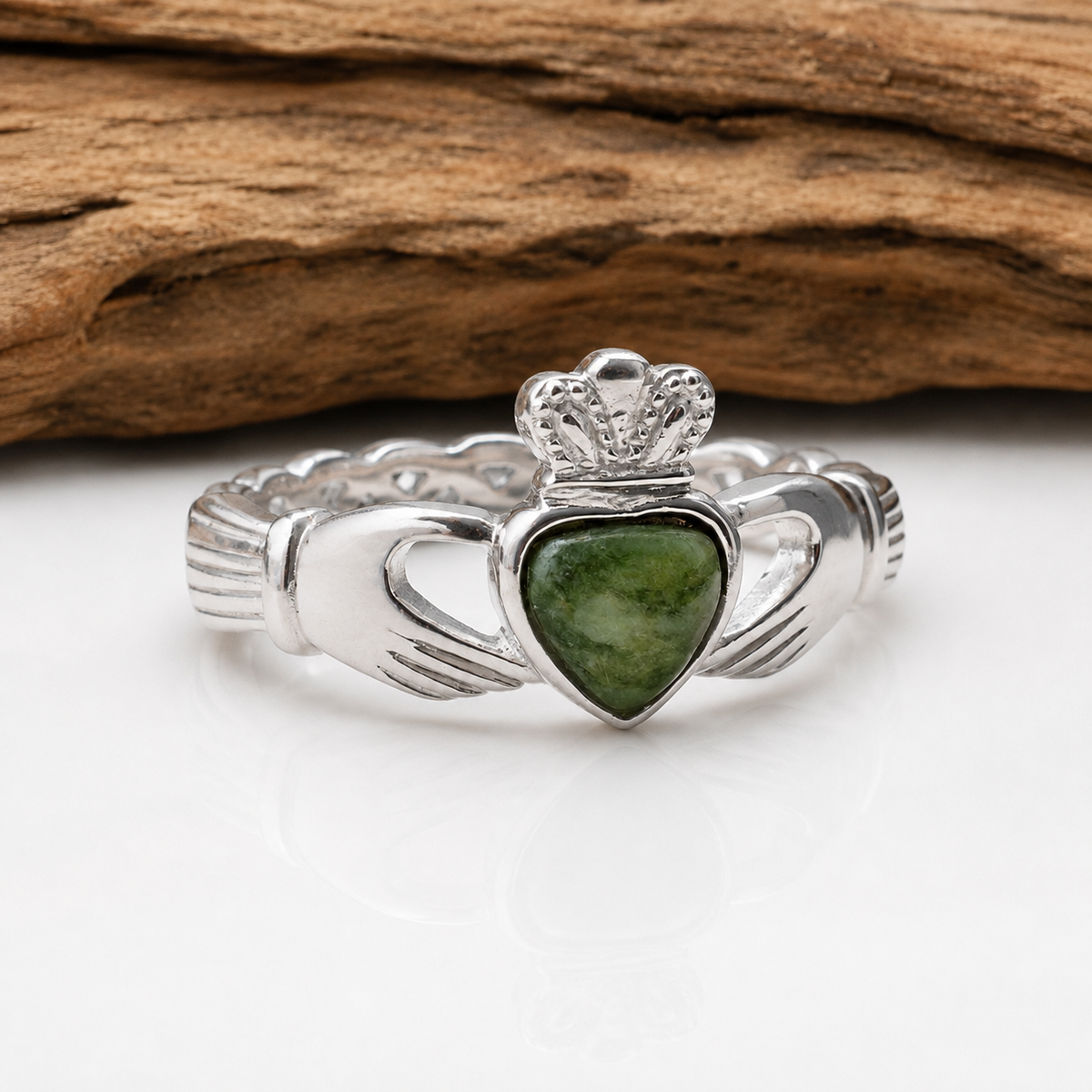
Irish rings have carried meaning in plenty of other ways too, from Claddagh designs to Celtic-inspired patterns.
If you like the idea of jewellery that comes with a story attached, you can explore our Celtic rings here.
Then Halloween Crossed the Atlantic
This is where the story becomes global.
During the nineteenth century, enormous numbers of Irish people left Ireland for the United States, particularly during and after the Great Famine.
The Library of Congress estimates that as many as 4.5 million Irish people arrived in the United States between 1820 and 1930.
They brought traditions with them.
Irish and Scottish immigrants helped carry Halloween customs such as disguises, mischief and seasonal celebrations into North America.
Once there, those customs began mixing with other traditions.
House visiting evolved.
Halloween celebrations grew larger.
Newspapers, shops, sweets, decorations and eventually films helped turn Halloween into the enormous cultural event we know today.
America did not simply “steal” Irish Halloween.
It transformed it.
And then, in a funny circular journey, the American version travelled back across the Atlantic.

So Is Halloween Irish?
The word Halloween itself comes from All Hallows' Eve, the evening before the Christian Feast of All Saints.
The customs surrounding the night, however, absorbed traditions connected with Samhain, Irish folk belief, seasonal games, guising, food, divination and supernatural stories.
Then emigrants carried many of those traditions abroad.
So modern Halloween is not one ancient festival frozen in time.
Some pieces are Christian.
Some are Irish.
Some are Scottish.
Some are American.
And some are much newer than people realise.
But Ireland is stitched right through it.
And What Did You Wear for Samhain?
Probably not a polyester witch costume.
Samhain marked the movement into winter.
That meant cold weather, darker evenings and the beginning of the part of the year when warm clothing mattered again.
Which makes traditional Irish knitwear feel surprisingly appropriate for the season.
Aran sweaters and cardigans may not be ancient Samhain costumes, but they belong naturally to the landscape and weather that shaped the festival.
Celebrate the Irish Side of Halloween
You do not need to recreate an ancient festival to enjoy where the story began.
Bake or buy a barmbrack.
See who gets the ring.
Carve a turnip if you are feeling ambitious.
Tell a ghost story.
Take a walk before it gets dark.
And maybe do not go poking around fairy forts afterwards.
Then, if you want something Irish for the season, explore our Samhain Edit, bringing together Aran knitwear, tweed, hats, Celtic jewellery, pocket watches and Ogham pieces chosen for autumn.
But underneath all of that is something much older.
The harvest finishing.
Winter arriving.
People gathering around food and fire.
A little curiosity about the future.
And one night of the year when the world was believed to feel just slightly stranger than usual.
That part of Halloween still feels very Irish.